
What Market Research in the UAE Actually Covers
Last Updated: 14 June 2026
The UAE produces a significant volume of published sector data — trade statistics, spending reports, growth projections across construction, healthcare, retail, and F&B. For most strategic decisions, that data provides a starting point. It rarely provides an answer.
Custom market research in the UAE closes the gap between what published indicators show and what real commercial conditions look like. The questions that matter are specific: whether demand for a particular product or service is genuinely accessible in this market, how established competitors actually price and position themselves beyond their public claims, where distribution structures exist and how they function, and what realistic market penetration looks like for a company entering or expanding in a defined sector.

B2B market research in the UAE requires particular attention to this gap. Sector-level market size figures rarely reflect the procurement structures, vendor relationships, and buying behavior that determine whether a B2B business can gain traction — or whether it will spend months chasing prospects already locked into existing supplier agreements.
Dubai and Abu Dhabi are not the same market. Dubai’s commercial activity is driven by private sector competition, high business density, and strong international exposure across most sectors. Abu Dhabi’s demand is more concentrated in government-linked projects, institutional procurement, and regulated industries — with longer sales cycles and different access requirements. Research design, data sources, and validation methods differ between the two accordingly.
What UAE Market Research Covers
Market research projects in the UAE are structured around validation layers, not generic research templates. The combination varies by sector and business objective, but the core areas of analysis remain consistent across market entry, expansion, and investment engagements.
Market Size and Demand Analysis
Published market size figures for UAE sectors are widely available and widely misread. Top-down estimates — “the UAE F&B market is worth USD X billion” — describe the total pool, not the portion accessible to a specific business. Demand analysis in practice means quantifying the realistic addressable segment: accounting for existing competitors, distribution constraints, price point positioning, and how concentrated demand actually is within specific geographies or customer groups. Bottom-up validation, built from real transaction data and primary inputs, typically produces figures significantly lower than headline statistics — and far more useful for investment decisions.
Customer Segmentation and Behaviour in the UAE
The UAE’s consumer and B2B population is structurally different from most markets. Roughly 90% of the population are expatriates, with nationality, income tier, and length of residency each influencing purchasing decisions in ways that standard demographic segmentation misses. In B2B markets, buying committees are common, procurement decisions are often driven by relationships rather than price alone, and the distinction between decision-maker and budget holder frequently matters more than in European or American contexts. Customer research in the UAE needs to account for these dynamics — not assume they mirror home-market behavior.
Pricing Benchmarks and Willingness to Pay
Pricing in the UAE operates across a wide range within most sectors, and the relationship between price and perceived quality is stronger than in many markets. Premium positioning is viable in categories where it would struggle elsewhere — but it requires clear signals. Willingness-to-pay analysis identifies the price thresholds at which demand shifts, how different customer segments respond to pricing, and where competitors have left gaps. This matters particularly in sectors such as healthcare, professional services, and F&B, where price anchoring significantly shapes market expectations.
Competitor Landscape and Positioning Gaps
Competitor analysis in the UAE goes beyond reviewing company websites and LinkedIn pages. The most useful competitive intelligence comes from understanding how competitors actually behave in the market — their real pricing (which often differs from published rates), their actual client base, the gaps in their service delivery, and where they are overextended. In fragmented markets such as professional services or manufacturing inputs, competitor mapping frequently reveals that two or three operators dominate accessible demand while the rest divide a small residual share. Identifying those gaps is what makes positioning decisions commercially grounded rather than optimistic.
Market Entry and Distribution Structure
The route to market in the UAE is rarely straightforward. Direct sales, distribution partnerships, freezone structures, mainland operations, and agent agreements each carry different cost profiles, timelines, and access to specific customer segments. Entry strategy research maps which route is viable given sector dynamics, identifies potential distribution partners and assesses their track record, and models the commercial implications of each option. In sectors with dominant distributors — construction materials, healthcare equipment, FMCG — understanding the distribution structure is often more valuable than understanding the end customer.
Regulatory and Operational Constraints
Licensing requirements, sector-specific approvals, and operational constraints in the UAE vary significantly by activity and emirate. Healthcare providers navigate MOHAP and DHA approvals; food businesses require municipality clearances; industrial operations involve MOEI and specific freezone regulations. Regulatory analysis in market research identifies what approvals are required, realistic timelines for obtaining them, and whether any constraints — ownership restrictions, local partner requirements, import limitations — materially affect the business model’s viability before investment is committed.
Industrial Market Analysis in the UAE: Sector-Specific Analysis for Market Entry
Industrial research in the UAE requires sector-specific analysis rather than broad assumptions about market growth. Each industry — from construction materials and manufacturing to healthcare, logistics, and real estate — operates under different demand drivers, regulatory conditions, and competitive structures.
For companies entering or expanding in these sectors, research focuses on quantifying demand at a practical level, understanding procurement dynamics, analysing competitor capacity and pricing, and identifying realistic opportunities for positioning and growth. This level of analysis is particularly important in the UAE, where market size alone does not guarantee accessible demand. This is why industrial market research in the UAE focuses on practical demand validation rather than high-level growth assumptions.
Selected Project Examples
The examples below show how market research is applied in practice — the business questions that triggered the project, the approach used, and what the findings produced.
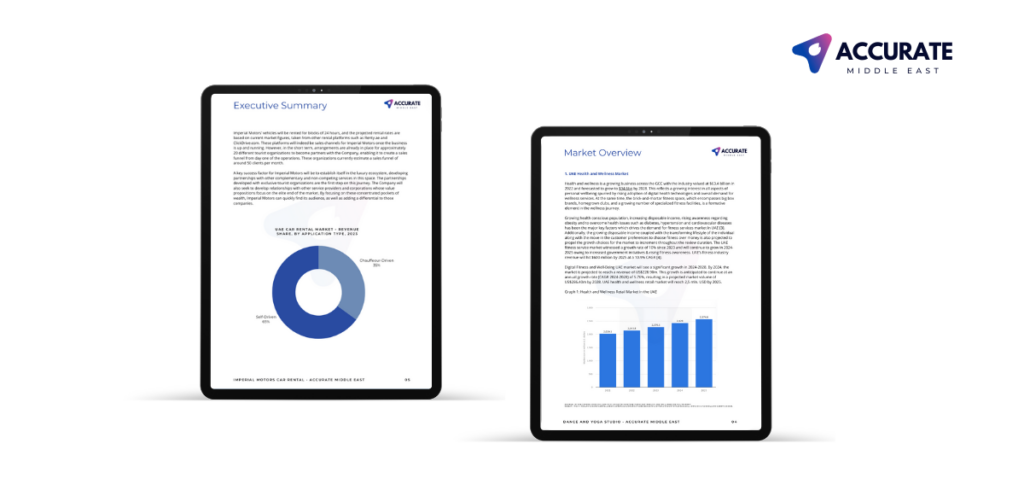
Market Research Process in the UAE
European Leather Brand — UAE Market Entry (Consumer + Trade)
Challenge: A European leather handbag brand in the affordable premium segment planned a direct-to-consumer launch in the UAE. The key unknowns were where mid-luxury buyers actually shop, how local retail dynamics differ from European markets, and which price positioning would work without undermining brand perception.
Research: Store-traffic observation across mall formats in Dubai and Abu Dhabi, structured interviews with distributors and retail buyers, and customer profiling across target income segments.
Finding: Mid-luxury buyers in Dubai and Abu Dhabi showed significantly stronger purchase intent in boutique-format stores within community and lifestyle malls than in large flagship shopping centres — the opposite of the default assumption for premium retail entry.
Result: The brand adjusted both its retail location strategy and pricing tier based on the findings. The direct-to-consumer launch delivered measurable sales growth within the first six months of operation.
Tiles Manufacturer — UAE Production Facility Assessment
Challenge: A regional tiles manufacturer was evaluating whether to establish a production facility in the UAE. The decision required understanding real local demand, mapping the competitive supply structure, and assessing whether domestic production could offer a credible advantage over established importers.
Research: Import and export data analysis, construction sector demand forecasting, competitor capacity benchmarking, and cost modelling for site selection and phased investment planning.
Finding: Real estate developers in the UAE showed consistent unmet demand for locally produced, customised tiles with shorter lead times — a gap existing importers could not fill due to inventory constraints and standardised product ranges.
Result:The client committed to a phased investment plan targeting both the UAE domestic market and the wider GCC construction sector, positioning around delivery speed and customisation rather than competing on price against established importers.
Custom Market Research Cost in Dubai and Abu Dhabi
Dubai’s economic growth and sector diversification continue to attract new businesses, supported by official data and market insights published by Dubai Chamber of Commerce.
Market research price in the UAE depends on the scope of validation required, including market size analysis, customer insights, competitor intelligence, and feasibility assessment. Projects can range from focused demand validation to full-scale market entry studies with primary research and financial modeling.
The cost of market research in the UAE depends on the level of validation required — from targeted demand checks to full market entry studies with primary research and financial modelling.
| Project Size | Typical Duration | Description | Estimated Cost (AED) |
|---|---|---|---|
| Targeted Study | 1.5 – 2 weeks | Focused market scan with targeted validation (survey/focus group), including competitor overview | AED 16,000 – 25,000 |
| Standard Market Study | 4 – 6 weeks | Structured market analysis combining demand assessment, trend mapping, and primary validation inputs | AED 35,000 – 45,000 |
| Full Market Entry Study | 8 – 10 weeks | Comprehensive market entry study with expert interviews, in-depth analysis, and integrated business intelligence layer | AED 65,000 – 85,000+ |
Note: Actual pricing may vary depending on sector, data availability, and whether regulatory or financial validation is required.
Most projects are tailored to specific business questions and may combine multiple research layers. To receive an accurate estimate aligned with your market entry or expansion objectives, request a custom proposal below.
Why Companies Choose Accurate Middle East for UAE Market Research
Most market research firms operating in the UAE offer the same product: a report assembled from secondary data, formatted to look like primary research. The difference shows up in what the findings can actually support — and what they can’t.
Accurate Middle East operates as a senior-led consulting team, not a data processing firm. Every project is led by consultants with 12–20+ years of direct market experience in the UAE and Saudi Arabia — not managed by a senior partner and executed by junior analysts. This matters in a market where ground-level knowledge, sector relationships, and the ability to read between published data and commercial reality are what determine whether research is useful.
Research methodology combines institutional secondary sources with direct primary validation — structured interviews with industry participants, field surveys conducted by an on-ground team across the UAE, and access to a proprietary panel of 50,000+ B2B and consumer respondents across the GCC. Where relevant, competitive intelligence includes real-market validation: pricing checks, mystery engagement with competitors, and direct assessment of how market players behave beyond their public positioning.
Projects are custom-scoped to a specific business decision. No templates, no off-the-shelf sector reports. Each engagement begins with a defined question — whether the market is accessible, whether the business model is viable, where the competitive gap exists — and is structured to answer it.
In practice, this means:
- Every project is led by a senior consultant with 12–20+ years of UAE and KSA market experience;
- Field research is conducted by an on-ground team — not outsourced or remote;
- Access to a proprietary GCC panel of 50,000+ B2B and consumer respondents
- 100% custom scope — no templates, no pre-packaged sector reports
Start a Market Study Project in the UAE
Market research in the UAE is most effective when it is aligned with a clear business decision — whether entering the market, expanding operations, or evaluating an investment. Our work focuses on validating demand, assessing competition, and defining realistic market entry strategies based on sector-specific dynamics.
Each engagement is tailored to the level of analysis required, combining market data, primary validation, and strategic interpretation to deliver clear, decision-ready outcomes. Contact us via WhatsApp or call at +971 50 559 5603. Or request a UAE market research proposal to receive a structured scope and timeline aligned with your objectives, by filling in our brief form.
Typical response time: within 24 hours with a tailored scope and indicative budget.
 |
|
Author: |
|
| Dr. Elena Zhukovskaya Senior Consultant, Partner |
|
|
20+ years of experience in market research, business management, investor relations, and brand communications across the UAE, KSA, and GCC. Author of 50+ publications and a regular speaker at leading business events in the region. Linkedin profile |